
air conditioning · HVAC maintenance
Why & how to clean your A/C condenser coils
Learn why blocked condenser coils matter, when to inspect them, and how to rinse the fins without damaging your A/C unit.
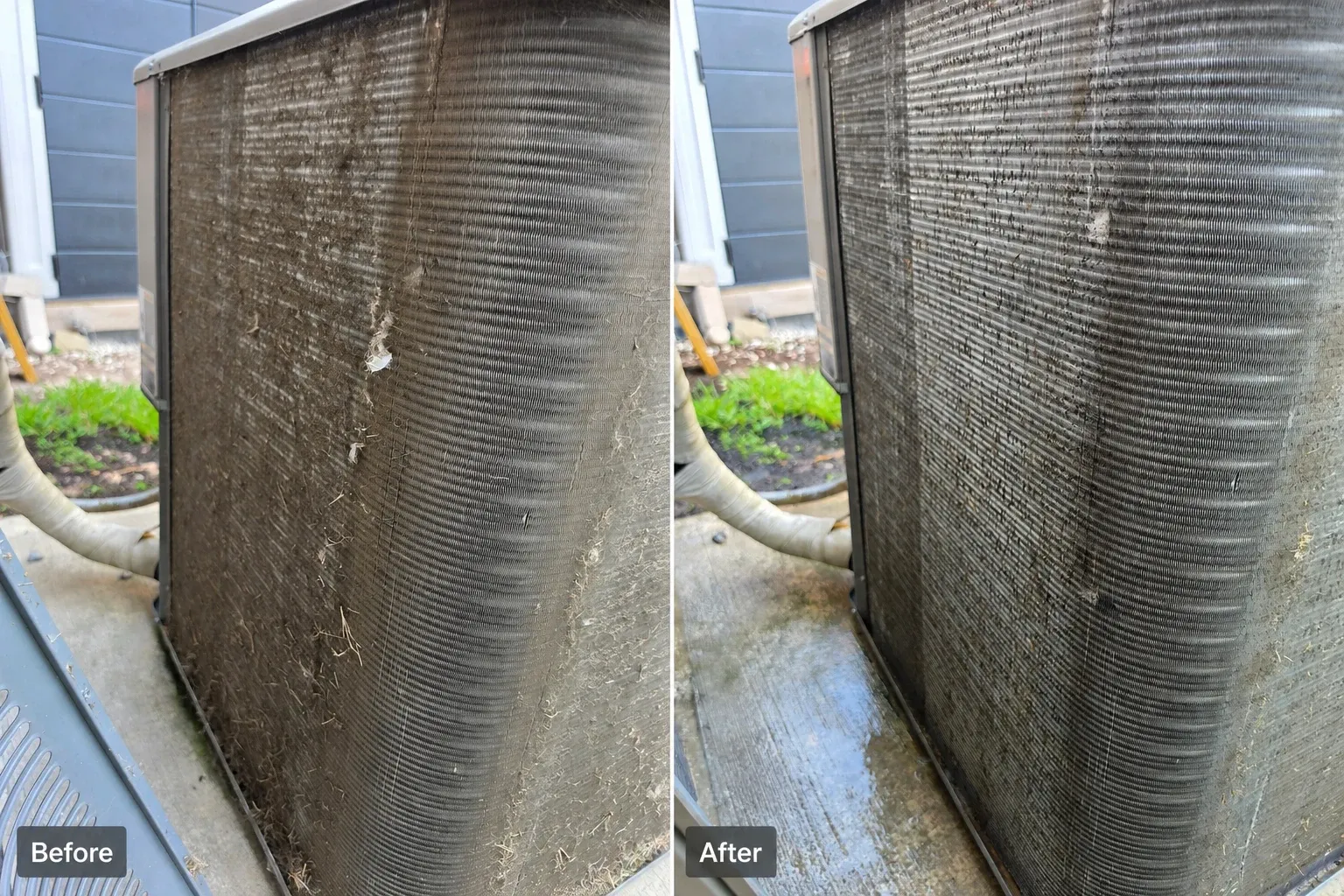
Your A/C condenser coils. The plentiful, super thin metal fins on that A/C box outside that whoosh the heat away. Unlike us, they do not like warm, cozy blankets—especially ones of caked-on dust, grass clippings, pollen, and whatever other airborne debris. Dependent upon your climate and if you’re in a new neighborhood still undergoing frequent construction, you probably need to inspect this about once a year. That pretty before photo you saw up there? Yeah, that was after right about one year. So you need to clean it—but why, how often, and how and with what?
Why should you care?
Well, if you live in an area where A/C is particularly mandatory and always hard at work during the summer (Texas, Arizona), you probably well know it’s the larger part of your electricity bill. You’ve also probably heard or even experienced how much it is to replace a unit (ouch!). Well, the longer you let stuff build up on your condenser coils, the less efficiently they dissipate the heat pulled out of your home, and the longer and harder your system has to run. That means more electricity, and more strain on your system. No bueno.
Surprisingly, there haven’t been too many statistically significant studies on this, but we have some rough efficiency estimates and ranges based on them. For coils that are just a little bit dusty, the number might be around 5–10%. For a medium amount to a lot of debris that’s really blocking airflow, anywhere from 10–30% efficiency loss and potentially an overheating system. Energy use is very close to that same percentage but technically and typically just shy. So in the middle of that range, you may be looking at saving about $20–30 a month.
How often should you do it?
Inspect it about once a year, and more often around construction, heavy pollen, grass clippings, or similar debris. Clean it when the fins are visibly blocked. If it’s just a little bit dusty, maybe save yourself the trouble unless you’re bored. If it’s looking pretty well covered and clogged up, it’s probably due for a good rinse.
How do you clean ’em?
Convinced? Oh right, you’re waiting to see how much effort this involves. Well good news—not too much at all. Before you start, turn the A/C off at the thermostat, then shut off the outdoor unit at its nearby disconnect or dedicated breaker. This protects you and keeps the fan from starting while you work.
Firstly—carefully. These are super thin metal so that they can dissipate heat efficiently, so they will bend and distort rather easily. Just be mindful not to put any real pressure on them. Try to bang/bump them as little as possible, and don’t use anything above the shower setting on your spray head (definitely not jet or a pressure washer).
For a basic homeowner clean, leave the unit assembled and gently rinse whatever coil surface is accessible from the outside. Only open the unit if your exact model’s manual explicitly describes how and you’re comfortable following it; otherwise, call an HVAC professional.
For cleaning the coils, honestly plain simple water does most of the work. Give the coils a good rinse (shower setting, never jet or even full!), watch the dirt run off, and you’re all set. If you wanna be a little more thorough, there’s products such as the Arm & Hammer “HVAC Coil Cleaner” spray foam that I’ve personally used so far. Spray them on, let them foam for a couple minutes, and same deal—rinse and you’re all set.
Sources
- Fouling and its effects on air-cooled condensers in split system air conditioners (RP-1705) · Taylor & Francis, accessed August 23, 2026
- An experimental study on the effect of room setpoint temperature, and evaporator/condenser fouling on performance of a ductless split type air conditioner · Elsevier, accessed August 23, 2026
- How to clean condenser coils · Trane, accessed August 23, 2026
- How to clean an A/C unit · Carrier, accessed August 23, 2026
- HVAC coil cleaner safety data sheet · DiversiTech, accessed August 23, 2026